Saturday, 30 March 2019

What is Engineering Mechanics?

The state of rest and state of motion of the bodies under the action of different forces has engaged the attention of philosophers, mathematicians and scientists for many centuries. The branch of physical science that deals with the state of rest or the state of motion is termed as Mechanics. Starting from the analysis of rigid bodies under gravitational force and simple applied forces the mechanics has grown to the analysis of robotics, aircraft's, spacecrafts under dynamic forces, atmospheric forces, temperature forces etc.
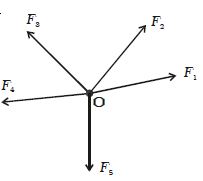
Engineering Mechanics IES ESE Ace Academy Handwritten Notes Free Download PDF
Archimedes (287-212 BC), Galileo lasac Newton (1642-1727) and Einstein 0878-1955) have contributed a lot to the development of mechanics. Contributions by varignon, Euler, D. Alembert are also substantial. The mechanics developed by these researchers may be grouped as
(i) Classical mechanics Newtonian mechanics
(ii) Relativistic mechanics
(iii) Quantum mechanics/wave mechanics
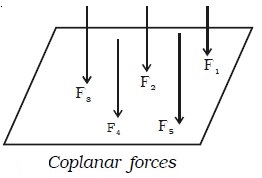
Engineering Mechanics IES ESE Ace Academy Handwritten Notes Free Download PDF
Sir Issac Newton, the principal architect of mechanics, consolidated the philosophy and experimental findings developed around the state of rest and of motion of bodies and put forth them in the form of three laws of motion as well a the law of gravitation, The mechanics based on these laws is called Classical mechanics or Newton mechanics. Albert Einstein proved that Newtonian mechanic fails to explain the behavior of h speed (speed of light) bodies He put forth the theory of Relativistic Mechanics Schrodinger (1887-1961) and Broglie (1892-1965) showed that Newtonian mechanics fails to explain the behavior of particles when atomic distances are concerned. They put forth the theory of Quantum Mechanics
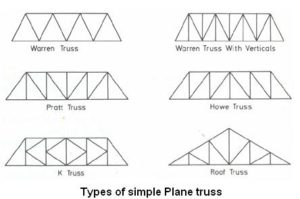
Engineering Mechanics IES ESE Ace Academy Handwritten Notes Free Download PDF
Engineers are keen to use the laws of mechanics to actual field problems. Application of laws of mechanics to field problem is termed as Engineering Mechanics.

Thursday, 21 March 2019

Fluids & Difference Between "Air" & "Liquids"

Greeting to you, this post is about giving you some information about fluids and difference between "Air" & "Liquids". So lets get started.

Fluids:  

        The Substances which have the tendency to flow are known as fluids. liquids and gases are fluids e.g air, water, oil etc.

Fluids Mechanics:

Fluid mechanics is the study of :
a) Physically behavior of fluids & the laws governing them.
b) Action of forces on fluids and how fluids will flow.

Fluid Mechanics has three divisions :

1.Hydrostatics : Study of mechanics of fluids at absolute or relative rest, the fluid molecules in this are supposed to have no shearing stresses on them.

2.Kinamatics : Study of translation, deformation and rotation of fluid molecules without considering the forces and energies that caused the motion.

3.Dynamics : Study of relations between velocities and accelerations and the forces which are exerted by or upon the moving fluids.

Liquids & Gases.

Liquids

1. Given mass of liquids have fixed volume. However it changes and acquires the shape of container but if the container has more volume then liquid we poured then remaining part of container remains free.

2. liquids are in-compressible for all practical purposes.


3. Pressure and temperature have practically no effect on the volume of a liquid.


4. Water, kerosene, petrol etc are liquids

Gas

1. Given mass of gas has no fixed volume and it expands continuously to completely fill the whole space of the container hence no free surface is formed.


 2. Gases are readily compressible

 3. A gas expands infinitely in the absence of pressure and contracts readily under pressure.

 4. Air, ammonia, carbon dioxide etc are gases.